
CALL US 24/7
(760) 420-0166
OPENING HOURS
Mon - Fr 9:00 am - 5:30 pm
ADDRESS
3760 Oceanic Way STE 501, Oceanside, CA 92056
29
May
Share
Comments Off on Roof Repair vs. Roof Replacement News
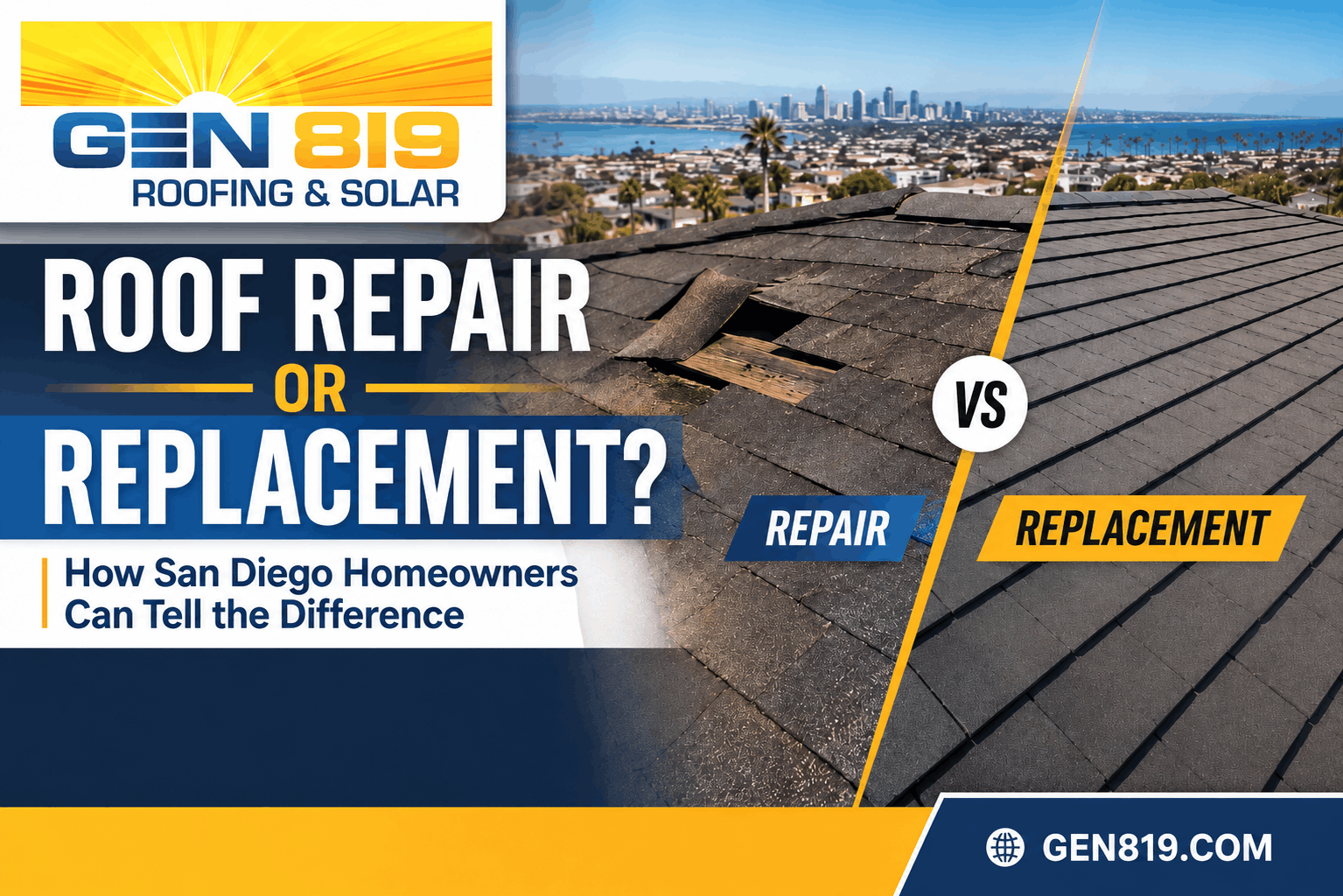
Roof Repair vs. Roof Replacement
The first real rain after a long San Diego summer has a way of revealing things. A faint brown ring appears on a bedroom ceiling. A few shingles turn up in the yard after a Santa Ana blows through. A drip shows up in the garage that was never there before. None of these tell you what you actually need to know, which is whether you are facing an afternoon repair or a five-figure replacement.
That is what makes this decision so stressful. The question is not whether something is wrong. It is how deep the problem goes. A ceiling stain might trace back to a single cracked flashing, or it might be the visible edge of water that has been quietly rotting the decking for months.
This guide walks through the signs that point toward a repair, the signs that point toward a replacement, and the San Diego climate factors that often tip a borderline case one way or the other. At Gen819, we have been making this call for local homeowners since 2008, and the goal here is to help you understand what you are dealing with before anyone climbs onto your roof.
The Quick Answer
Lean toward a repair when the damage is recent, confined to one area, and your roof still has years of life left. Lean toward a replacement when the damage is widespread, keeps coming back, or your roof is near the end of its service life. Most situations sort cleanly into one of these once you know what to look for. The rest of this guide is about recognizing which one you are in.
Signs a Repair Will Probably Do the Job
Not every roof problem is a crisis. Many of the issues San Diego homeowners run into are localized and straightforward, especially when caught early.
The clearest case for a repair is damage isolated to one small area with a single, traceable cause. A branch cracks a few tiles, a pipe boot wears out, flashing around the chimney splits. The rest of the roof is sound, the source of the trouble is obvious and contained, and a skilled roofer can restore it without touching anything else. The key word is traceable: when you can point to exactly where and why, you are almost always looking at a repair.
Timing matters too. A handful of shingles displaced after a wind event is normal wear, not a reason to replace a roof. As long as the damage stayed on the surface and the wood decking beneath is solid, with no sagging, soft spots, or moisture working into the structure, a repair will usually do the job. The trouble starts when damage reaches below the surface, which is where the next section comes in.
Signs You Are Looking at a Replacement
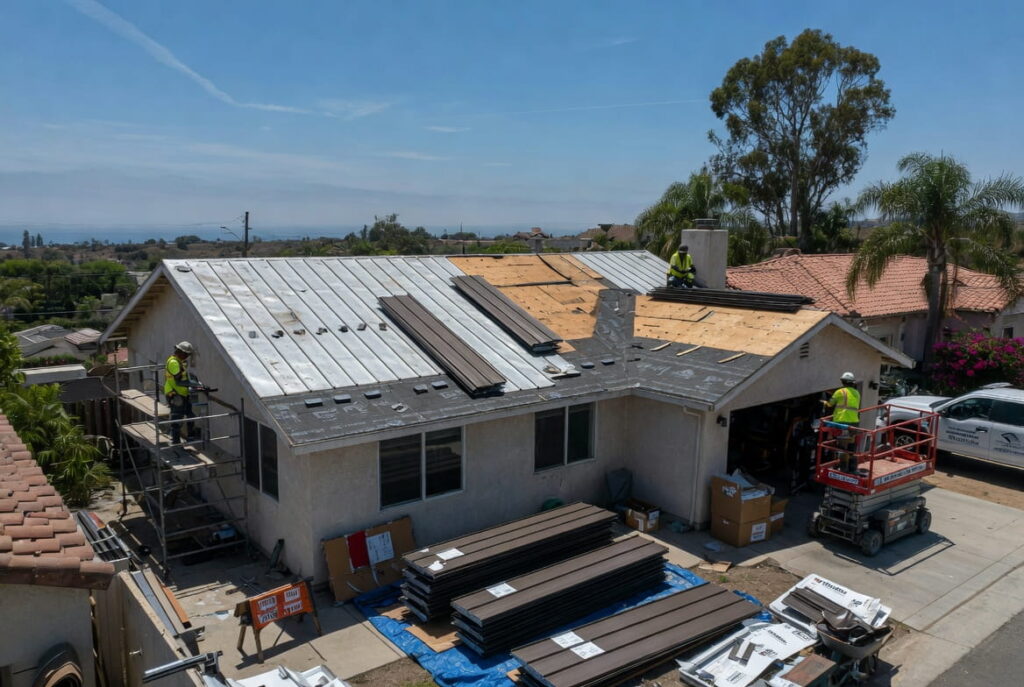
Some problems go beyond what a repair can reasonably solve. When you see several of these together, replacement is usually the more sensible and cost-effective path.
Your roof is at or near the end of its lifespan. This is the single most important factor, and it changes the math on everything else. Once a roof approaches the end of its service life, repairs become a losing game: you pay to patch a system that will need replacing soon regardless. If you are not sure where your roof stands, our guide to San Diego roof lifespans breaks it down by material.
The damage spans multiple areas or slopes. A problem in one spot is a repair. Problems on several sections of the roof point to a system failing as a whole, which rarely makes sense to address piece by piece.
Leaks keep coming back, or show up in more than one place. This is the flip side of the traceable leak above. When patching one leak only for another to appear nearby, the underlayment or the broader system has broken down.
The roofline sags or feels soft underfoot. This is the most serious sign on the list. Sagging or spongy areas point to structural trouble beneath the surface, usually from trapped water in the decking or framing. It is not cosmetic, and it needs immediate professional attention.
The whole surface is wearing out. Granules filling your gutters mean asphalt shingles are losing their protective layer. Widespread cracking or brittleness across a tile roof signals the same end-of-life fatigue. When deterioration is spread across the entire roof, replacement is the practical answer.
You have repaired the same roof again and again. At a certain point the repairs are no longer solving the problem, and the money spent patching would have been better put toward fixing the underlying issue once.
The San Diego Factor: What Makes Our Climate Different
Most roofing advice online is written for a general national audience, which means it misses the conditions that actually age roofs here. San Diego’s climate is gentle by reputation but surprisingly hard on roofing materials.
Relentless UV exposure. With more than 260 days of sunshine a year, local roofs absorb an enormous amount of ultraviolet radiation over their lifetime. UV is the most underestimated cause of roof aging: it breaks down asphalt, makes tiles and underlayment brittle, and degrades sealants and flashing long before any dramatic weather arrives. A roof can look fine from the curb while the sun has quietly cut years off its life, which is why some San Diego roofs need replacing earlier than their advertised lifespan suggests.
The marine layer and salt air. For homes near the coast, the daily cycle of marine moisture and salt-laden air works against a roof around the clock. Salt accelerates corrosion on metal components and fasteners, while persistent dampness breeds the kind of slow, hidden rot that goes unnoticed until it reaches the decking. Two roofs of the same age can be in very different shape depending on how close they sit to the ocean.
Santa Ana winds. Strong, dry gusts can lift and displace shingles or tiles already weakened by years of UV. A roof that was holding together adequately can suddenly start shedding material in a single wind event.
Rain that arrives all at once. San Diego goes long stretches without rain, then gets it in concentrated bursts that find every weak point at once. A roof that seemed fine through months of dry weather can reveal multiple leaks in one heavy storm, which is often the moment a homeowner realizes the problem is bigger than they thought.
Wildfire zones change the calculation. In much of the county’s inland and backcountry, the repair-or-replace decision is also a fire-resilience decision. If an aging roof is nearing replacement and your home sits in or near a high fire risk area, replacement is a chance to upgrade to a Class A fire rated material. The decision stops being only about leaks and starts being about safety.

The Decision Factors Beyond the Damage
Even once you have identified what is wrong, a few broader factors determine the smarter long-term move.
The most useful rule of thumb the roofing industry uses: when damage affects roughly 30% or more of the roof, or appears on multiple sides, replacement tends to beat a series of repairs. Below that threshold, targeted repairs usually make sense.
Cost over time matters more than today’s price. A repair is cheaper in the moment, but if you are likely to be back within a year or two, and again after that, the cumulative cost can quietly exceed a single replacement. How long you plan to stay shifts the calculation as well, though a sound roof helps a sale and a failing one often complicates it.
Two San Diego-specific factors are worth weighing. If you are considering solar, installing panels on a worn roof is a costly mistake, since they have to come off again when the roof is replaced; if your roof is already aging, replacing it first is almost always the right sequence (our article on whether your roof is ready for solar covers this). And in today’s California insurance market, upgrading an aging roof to a Class A fire rated material can improve your insurability and may qualify you for wildfire mitigation discounts, which can make replacement worth doing sooner.
One Mistake to Avoid in Either Direction
Homeowners tend to err in one of two ways. Some panic at the first stain and assume the worst, paying for a full replacement when an honest repair would have served them for years. Others ignore a small, fixable problem until water has spread into the decking and structure, turning what could have been an afternoon’s work into a major project. The goal is neither alarm nor avoidance. It is an accurate read of what your roof actually needs, which usually means getting eyes on it before the next big rain.

Why a Professional Inspection Is the Only Real Answer
The hardest part of this decision is that the most serious problems are the ones you cannot see from the ground. A homeowner can spot missing shingles or an obvious sag. What stays hidden is what often matters most: decking rotting beneath intact-looking tiles, underlayment that has failed, flashing giving way where no one can see it, moisture tracking through the framing.
A thorough inspection covers the full system, not just the surface. At Gen819 we assess the roofing material, the flashing around chimneys, vents, and valleys, the decking and structural components, attic ventilation, and the drainage paths that carry water off the roof. For hard-to-reach areas and flat roofs, we use drone inspections and thermal imaging to find moisture and hidden damage without tearing anything apart.
Just as important is who is doing the looking. A trustworthy roofer recommends a repair when a repair is what your roof needs, rather than pushing a replacement you do not require. As an employee-owned company serving San Diego County since 2008, that is the standard we hold ourselves to.
The Bottom Line
The choice comes down to a few honest questions. How extensive is the damage? Is it isolated or spreading? How old is your roof relative to its material? And how have San Diego’s UV, marine air, winds, and fire risk worn it down over the years? Answer those clearly and the right path usually reveals itself.
When you are ready for a real answer, a professional inspection from a contractor you can trust is the best place to start. If you have noticed any of the signs in this guide, call us at (760) 420-0166 or click here to schedule your consultation.
Recent Posts

Roof Repair vs. Roof Replacement
29th May 2026


Standing Seam Metal Roofs vs. Metal Shingle Roofing
29th Mar 2026


